


In early-stage companies, benchmarks tend to have a short shelf life.
You get requests like:
“We’re hiring for this role, we need a benchmark”
“Someone resigned. Come up with a counter offer”
“The salary couldn’t possibly be X, I hired for this role and it was Y”
So you pull some data or do some research, and solve that one pain point in that one moment.
Then the benchmark get's dropped and never looked at again.
This in spite of knowing that, eventually, you'll need to benchmark a role:
At the level above it
That is slightly similar, or
The same role in a different region
Turns out, that other benchmark we had could be adapted to all of these scenario's, and help you build a salary system, instead of a one-off disposable benchmark.
There's four steps you can take to do this (and a free tool to help):
1. Pull the whole job family (even part of it)
A job family is like a set of roles that do the same type of work, with the same sort of skills, but at different levels. HR is a job family. A HR Coordinator and HR Generalist would sit at different levels in the same job family.
2. Fit a line through it.
Let's say you just have data for those two roles, and they're level 1 and level 3, and the midpoints are 80k and 100k respectively. We can plot level 2 by fitting a line that intersects the two known data points and gives us our missing one.
We can do this in two common ways, by using a linear progression or an exponential one.
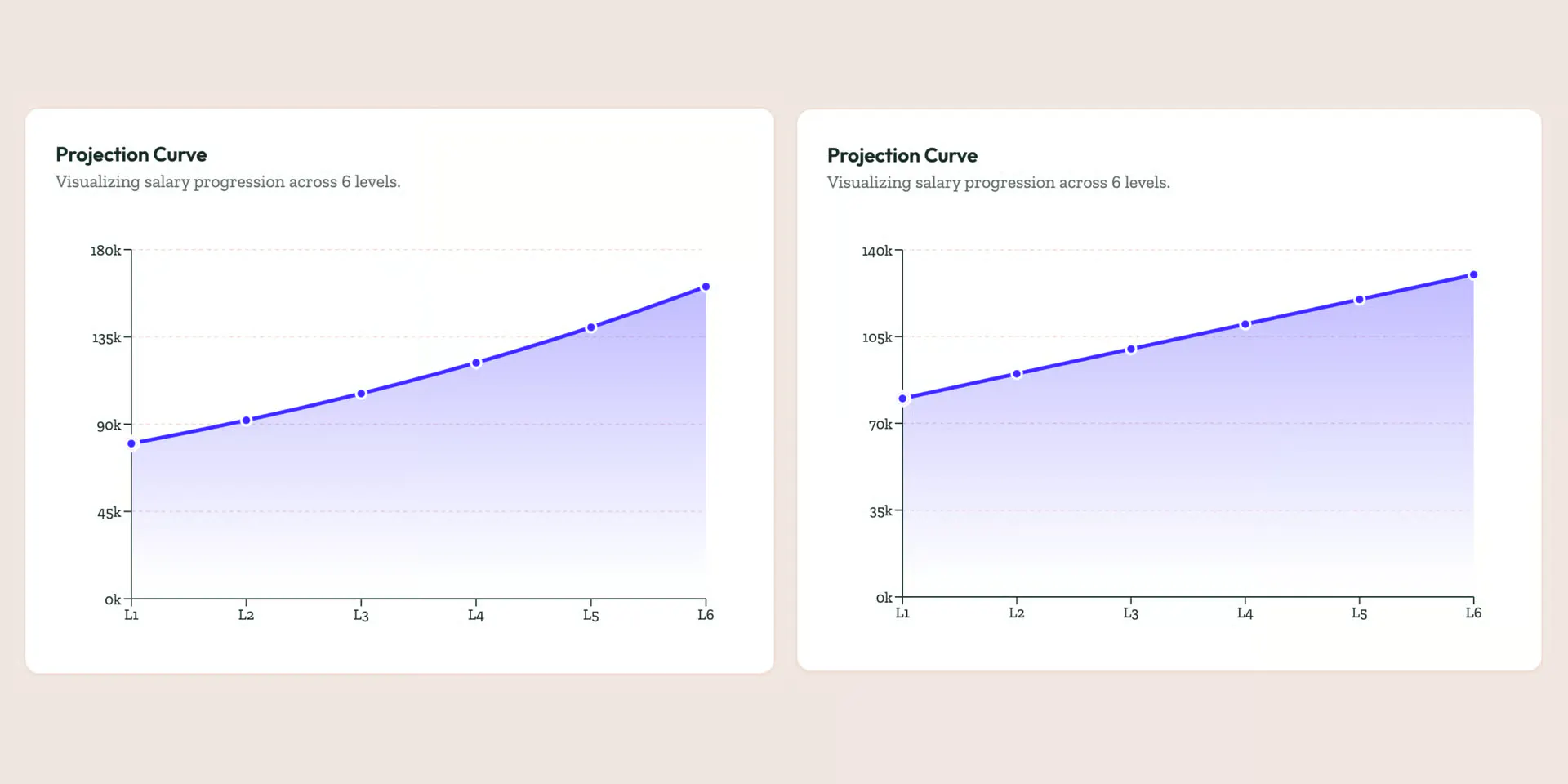
Exponential (left image) is where the values increase with a constant %
Linear (right image) is where the values increase with a constant $ amount
I built a tool you can use to do exactly this.
Using this, you can plot the salaries for as many levels as you have in your company. Some might just be small and only need 3, some might be large and have 8. It's up to you.
3. Set a range around each point
Most companies want a salary range, not just a salary point. So from here you can add a % either side of the mid-pint (15% is common) to give yourself some room to progress people from the start of the role to those who are higher-performers or more experienced etc.
4. Apply modifiers
Here's the fun part.
Once you've got a set of ranges for one job family (say: HR), you can answer those questions we had earlier.
We've already got all the salaries for the same role at different levels, so let's see how you would build a dataset for similar roles.
Let's say you have data that suggests Talent Acquisition sits 5% above HR in the market. You can now add a 5% premium to your HR dataset, and presto, you've got a whole new set of salary ranges for the 'sub-family' of Talent Acquisition.
Or maybe you want to hire overseas. Again, if you know roughly by how much salaries are different in the new country (once currency is adjusted) you can add a modifier to your original HR benchmarks and now you can hire those same roles in the new country.
It might look something like the below
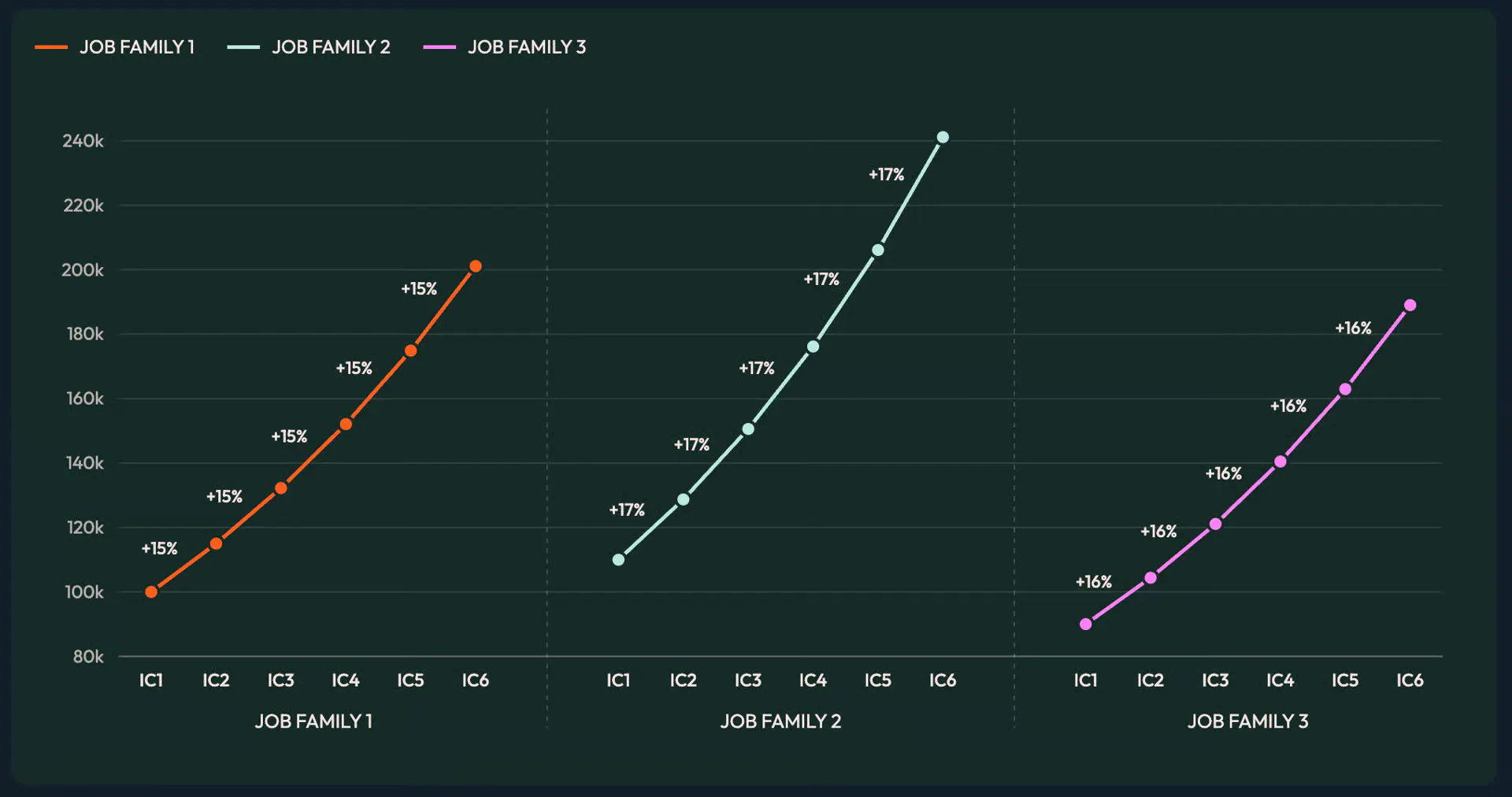
Now look, is this method flawless? No. Countries like India, for example, tend to have really high progression rates, so adapting a set of HR benchmarks from the US or Australia where jumps might be 15-20%, potentially will not work in a market like India where jumps can be 30-40% between levels. But the point is that you're able to get a starting point, and this gives you something to start with and adapt as you uncover this information.
All of this aids in saving you time, allowing you to move faster, and improves pay equity, to name but a few things.
So the next time someone asks you for an ad hoc benchmark, think about how you can turn it into a system vs something you dispose of straight after.
I went into this in a bit more detail in the latest edition of my newsletter, which you can subscribe to here (it's free) to read more about people and pay practices that help you actually answer the question: https://fndnseries.fndn.com.au/subscribe
What do you think? Does a tool (and method) like this help you turn salaries from a one off, disposable thing, into something you can repeat with confidence?