


Every conversation about AI in HR today seems to start with the same statements:
"AI won't replace HR." "The future is Human + AI." "HR professionals need to learn AI."
I agree. But after spending time experimenting with AI in my own HR work, I have started asking a deeper question:
Are we focusing too much on what AI can do, and not enough on what humans should continue to own?
Because in HR, efficiency is only one part of the equation.
Trust is another.
Over the past year, I have used AI to support many aspects of HR work — drafting policies, summarizing interviews, analyzing survey insights, creating learning content, preparing communication drafts, and reducing repetitive administrative tasks.
The productivity gains are undeniable.
But one thing has become even clearer:
The most valuable moments in HR are rarely the ones that require more speed.
They are the moments that require more understanding.
A difficult career conversation. A manager struggling with a team challenge. An employee sharing a concern. A leader making a decision that impacts people's lives.
These moments require more than information.
They require judgement, empathy, and accountability.
A Practical Filter: Where Should AI Play a Role in HR?
When evaluating whether AI should be part of an HR process, I ask three questions:
1. Is this about information or interaction?
If the task is about finding, organizing, or processing information, AI can create tremendous value.
Examples:
· Searching policies
· Drafting documents
· Creating learning materials
· Summarizing data
· Automating repetitive workflows
AI helps us move faster.
2. Does this require a decision or a recommendation?
AI can identify patterns.
It can highlight trends.
It can provide suggestions.
But decisions that impact people's careers and experiences need human accountability.
Examples:
· Hiring decisions
· Promotions
· Performance evaluations
· Compensation decisions
· Workforce planning
Data can support judgement. It should not replace judgement.
3. Does this moment require trust?
This is where the human role becomes irreplaceable.
Consider:
· Employee relations conversations
· Coaching discussions
· Conflict resolution
· Career development
· Sensitive feedback
· Organizational change
These are not transactions.
They are moments where employees decide whether they feel respected, heard, and valued.
And that responsibility cannot simply be delegated to technology.
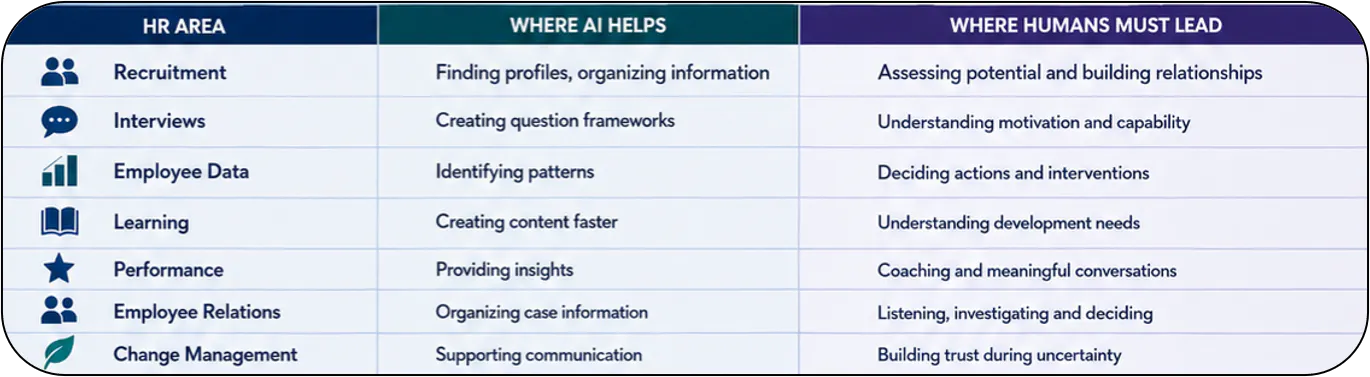
My AI + Human Ownership View
Article content
The pattern is simple:
The more predictable and repetitive the task, the more AI can help.
The more personal and meaningful the moment, the more humans matter.
AI Should Remove Friction, Not Humanity
For me, the biggest opportunity with AI in HR is not replacing HR work.
It is giving HR professionals more time to do the work that creates the most impact.
Less time spent on:
· Searching for information
· Formatting documents
· Creating repetitive reports
· Managing administrative tasks
More time spent on:
· Coaching leaders
· Building culture
· Supporting employees
· Solving business challenges
That is where AI can become a true partner.
My Reflection
I don't believe the future belongs to companies that automate the most.
I believe it belongs to companies that understand where automation creates value and where human connection creates meaning.
The best HR teams will not be those that ask:
"How much can we automate?"
They will ask:
"What should technology enable, and what should humans continue to own?"
Because the future of HR is not Human versus AI.
It is Human intelligence amplified by AI — with wisdom guiding the choices.
I would love to hear your thoughts:
What is one HR activity you believe AI should take over completely?
And what is one HR moment where human presence will always matter?