Not in theory. Not in two or five years. Right now.
That’s the conversation we’re bringing to In Good Company Stockholm on 11 November. ☕🇸🇪
Our next breakfast gathering is all about From AI Hype to Workforce Reality.
We’ll explore what AI transformation looks like in practice:
How are roles and skills changing?
Are employees getting the support they need to adapt?
Are managers ready to lead teams through this shift?
And what are organisations still figuring out?
At IGC, we believe the most valuable conversations happen when we move beyond headlines and share what we’re actually experiencing at work — including the questions we don’t have all the answers to yet.
This is an opportunity to exchange perspectives, learn from each other, and connect with fellow HR and People professionals navigating the same changes.
📅 Wednesday, 11 November | 8:00–10:00 AM 📍 Blique by Nobis, Stockholm ☕ Breakfast | 🎟️ Free to attend
Yesterday morning, Jaya and I hosted the very first In Good Company Stockholm breakfast, and I am still smiling about it.
The agenda
The plan was simple. A cosy breakfast, a warm welcome, and an open, honest space for HR and People professionals to talk about the real challenges we face every day. And on a busy Monday morning, 80 percent of those who registered showed up. That alone felt wonderful.
The discussion
What started with HR core topics quickly grew into a rich, lively and genuinely inspiring conversation about AI compliance, pay transparency in recruitment, HR automation and integrations. People were curious, generous and so refreshingly open. We almost lost track of time, which I think is the best compliment a conversation can get.
The reflections
We also gathered some lovely reflections and feedback from everyone, and we are taking them all forward for our next gathering. Thank you for helping us shape this chapter together. Someone also wrote "Thank you for everything!" on our flipchart, and that truly made my morning.
What I take away is this. People are not just looking for information. They are looking for a safe, warm place to think out loud with peers who understand their world. That is exactly what we want this chapter to be.
HR doesn’t always look like the best-practice case studies we see online. Sometimes, the most valuable conversations start with simply saying, “This is what we’re actually dealing with. How are you handling it?”
Join us for the first In Good Company Stockholm Chapter gathering, an intimate morning meetup for HR and People professionals who want to move beyond surface-level networking and have honest conversations about the realities of the work.
Over breakfast and fika, we’ll get to know one another before moving into facilitated peer discussions where you can bring a challenge, share an experience, hear what others are trying, and learn from perspectives across different organizations, roles, and stages of growth.
What to expect:
Coffee, breakfast, and fika with fellow HR and People professionals
Facilitated conversations around real workplace challenges
Candid discussion about what’s working and what isn’t
An opportunity to exchange experiences and practical ideas with peers
Meaningful connections beyond the usual networking conversation
No presentations. No pretending to have all the answers. Just a small group of People professionals willing to make HR conversations a little more real.
I'm thrilled to be stepping in as one of the new co-leads for the Stockholm chapter.
A little about me .. I work in HR Systems at Mercell here in Stockholm and right now my work is heavily concentrated on EU Pay Transparency compliance — building out job architecture, mapping roles into HiBob's Job Catalog and setting up JD frameworks and tracking systems. It's been a deep dive, and I'm excited to bring some of that hands-on HiBob experience into this community.
Community-building is also something I'm genuinely passionate about . I have worked with communities in Paris through my role at the American Library of Paris, and I'm looking forward to bringing that same energy here.
What I really appreciate about HiBob is what it stands for , bringing HR people together to learn from each other, share what's working (and what's not), and grow as a community rather than working in silos.
Looking forward to getting to know this chapter, hearing your ideas, and bringing everyone together for our next event in Stockholm!
Every conversation about AI in HR today seems to start with the same statements:
"AI won't replace HR.""The future is Human + AI.""HR professionals need to learn AI."
I agree. But after spending time experimenting with AI in my own HR work, I have started asking a deeper question:
Are we focusing too much on what AI can do, and not enough on what humans should continue to own?
Because in HR, efficiency is only one part of the equation.
Trust is another.
Over the past year, I have used AI to support many aspects of HR work — drafting policies, summarizing interviews, analyzing survey insights, creating learning content, preparing communication drafts, and reducing repetitive administrative tasks.
The productivity gains are undeniable.
But one thing has become even clearer:
The most valuable moments in HR are rarely the ones that require more speed.
They are the moments that require more understanding.
A difficult career conversation. A manager struggling with a team challenge. An employee sharing a concern. A leader making a decision that impacts people's lives.
These moments require more than information.
They require judgement, empathy, and accountability.
A Practical Filter: Where Should AI Play a Role in HR?
When evaluating whether AI should be part of an HR process, I ask three questions:
1. Is this about information or interaction?
If the task is about finding, organizing, or processing information, AI can create tremendous value.
Examples:
· Searching policies
· Drafting documents
· Creating learning materials
· Summarizing data
· Automating repetitive workflows
AI helps us move faster.
2. Does this require a decision or a recommendation?
AI can identify patterns.
It can highlight trends.
It can provide suggestions.
But decisions that impact people's careers and experiences need human accountability.
Examples:
· Hiring decisions
· Promotions
· Performance evaluations
· Compensation decisions
· Workforce planning
Data can support judgement. It should not replace judgement.
3. Does this moment require trust?
This is where the human role becomes irreplaceable.
Consider:
· Employee relations conversations
· Coaching discussions
· Conflict resolution
· Career development
· Sensitive feedback
· Organizational change
These are not transactions.
They are moments where employees decide whether they feel respected, heard, and valued.
And that responsibility cannot simply be delegated to technology.
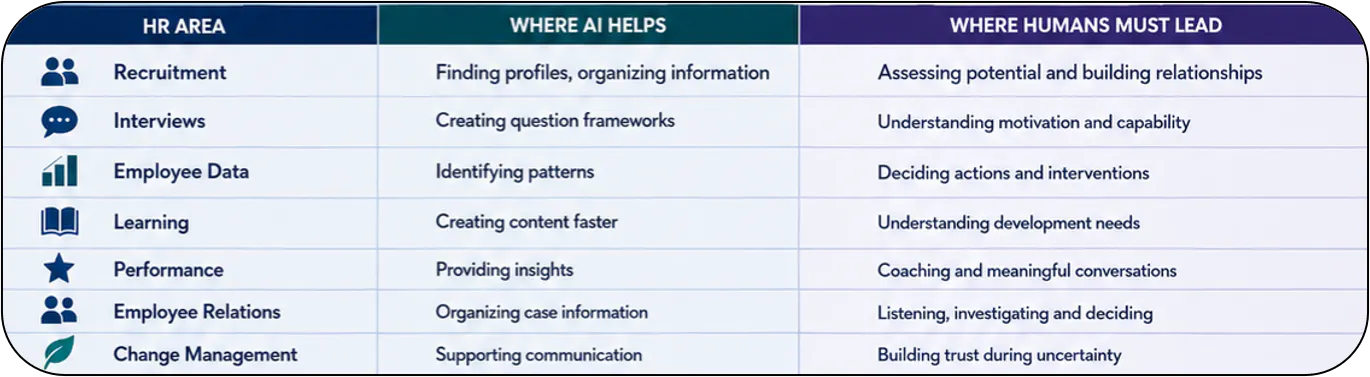
My AI + Human Ownership View
Article content
The pattern is simple:
The more predictable and repetitive the task, the more AI can help.
The more personal and meaningful the moment, the more humans matter.
AI Should Remove Friction, Not Humanity
For me, the biggest opportunity with AI in HR is not replacing HR work.
It is giving HR professionals more time to do the work that creates the most impact.
Less time spent on:
· Searching for information
· Formatting documents
· Creating repetitive reports
· Managing administrative tasks
More time spent on:
· Coaching leaders
· Building culture
· Supporting employees
· Solving business challenges
That is where AI can become a true partner.
My Reflection
I don't believe the future belongs to companies that automate the most.
I believe it belongs to companies that understand where automation creates value and where human connection creates meaning.
The best HR teams will not be those that ask:
"How much can we automate?"
They will ask:
"What should technology enable, and what should humans continue to own?"
Because the future of HR is not Human versus AI.
It is Human intelligence amplified by AI — with wisdom guiding the choices.
I would love to hear your thoughts:
What is one HR activity you believe AI should take over completely?
And what is one HR moment where human presence will always matter?