


We often talk about AI in HR as if we're waiting for the future.
But here's the interesting part: A lot of that future is already here.
AI can already screen CVs, draft job descriptions, match candidates to roles, answer employee questions, analyse engagement data, recommend learning, support performance reviews and help HR teams make sense of large amounts of information.
The technology isn't necessarily the biggest question anymore.
Our ability to rethink how HR work gets done is.
Recent SHRM research found that 39% of organisations surveyed had already adopted AI in their HR functions, with recruiting, HR technology, learning and development, and employee experience among the most common areas of use.
And Gartner predicts that by 2030, AI could perform up to 50% of today's HR activities.
That doesn't mean 50% of HR jobs disappear.
It means the work inside those jobs is going to change.
So what can AI actually do in HR today?
I've been mapping this out, and this is how I see the landscape.
I've grouped it into three simple questions:
What is the HR activity? What is AI already doing? And where does human judgment still matter?
The full picture is in the visual below:
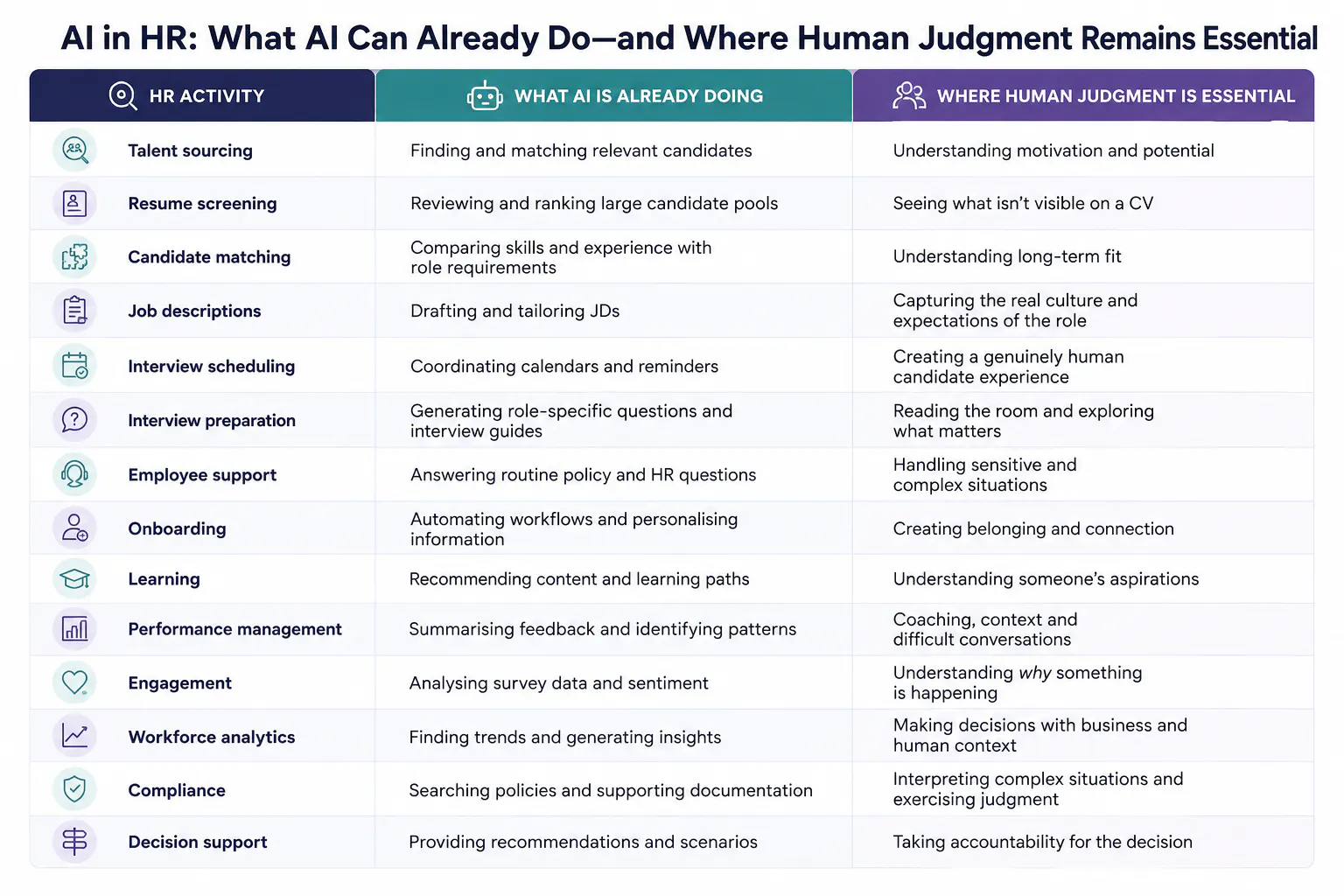
Looking at the different HR activities together, one pattern stands out.
AI is already becoming very good at finding, sorting, drafting, coordinating, analysing and recommending. But when we move closer to motivation, relationships, context, empathy, fairness and accountability, human judgment becomes much more important.
And this is where I think the conversation gets interesting.
AI is moving beyond automation
For a long time, we thought about HR technology mainly as a way to automate administration.
Send the reminder.
Create the report.
Schedule the interview.
Answer the FAQ.
But AI is moving into a different space.
It's starting to help us think.
It can surface patterns we might miss.
It can challenge our assumptions.
It can prepare us for difficult conversations.
It can help us explore different scenarios before making a decision.
That's a much bigger shift than simply automating tasks.
A recent Digital HR Leaders podcast series captured this change well: the starting point for AI shouldn't be the technology itself, but the work, the business problem and the decisions we want to improve.
I couldn't agree more.
But there's an important catch Capability doesn't equal readiness.
We shouldn't assume that because AI can do something, organisations are ready to use it.
SHRM found that 56% of HR professionals surveyed don't formally measure the success of their AI investments.
And McKinsey's 2026 HR Monitor points to a similar gap between AI experimentation and scaled impact.
So perhaps our next HR question shouldn't be:
"What AI tool should we introduce?"
Maybe it should be:
"What HR work should we redesign?"
What changes for HR professionals?
This is the part I find most exciting. If AI takes care of more of the searching, summarising, drafting, analysing and coordinating...
What do we do with the time we get back?
Hopefully, more of the work that requires us to be human.
More coaching.
Better manager support.
More thoughtful workforce decisions.
More time with employees.
Better conversations.
More attention to culture.
And perhaps, importantly, more time to challenge the business rather than simply respond to it.
Because the goal shouldn't be:
Do more HR with AI.
It should be:
Do better HR with AI.
My reflection
I don't think the biggest opportunity in AI for HR is replacing HR tasks. It's redefining what deserves our time.
AI can process information.
It can identify patterns.
It can prepare us.
It can even recommend what we might do next.
But HR professionals still need to decide:
What is fair?
What is right?
What does this person need?
What does this organisation need?
And sometimes...
What shouldn't we do, even if technology allows us to?
That's where the real value of HR may become even more important.
AI can handle more of the work.
But that gives us an even bigger responsibility to decide what work is worth doing.
A question I'm exploring: If AI could take away 30% of your HR workload tomorrow, which 30% would you happily give away—and what would you do with the time you get back?