


I was recently reading about how the conversation around AI agents is evolving across technology, business and HR.
It took me back to January 2025, when Jensen Huang, CEO of NVIDIA, made what sounded at the time like a futuristic prediction. At CES 2025, Huang suggested that AI agents could become a new digital workforce and famously said:
“The IT department of every company is going to be the HR department for AI agents in the future.”
It was a provocative idea.
But looking at the conversation today, I think the question has become much bigger than:
Who will manage AI agents?
The conversation is increasingly asking:
Who manages the agent? Who gives the agent authority? An agent increasingly becomes an enterprise actor Who defines the work it performs? Who evaluates its performance? Who is accountable for its actions? And ultimately, who designs the workforce in which humans and agents work together?
That last question may be the most important one.
How the Question Is Changing
Rather than looking at AI-agent commentary as a collection of predictions, I think it is more useful to see it as an evolution of questions. The technology has been developing for years, but One way I see the organizational conversation evolving is through a progression of questions.
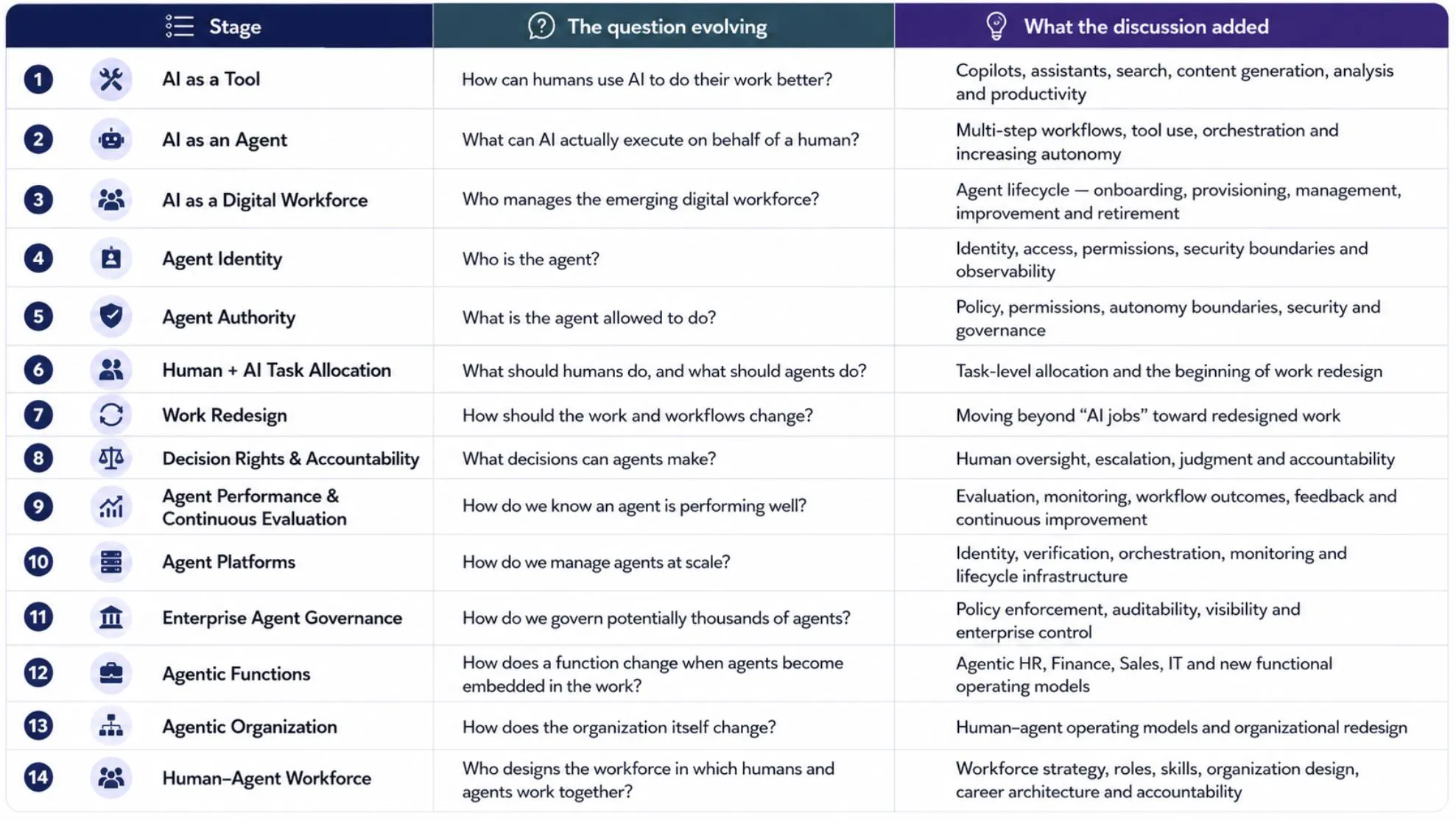
These aren't necessarily sequential stages of technological maturity. They are different organizational questions emerging around the same technology.
From AI Tools to AI Agents - The first generation of enterprise AI was largely about tools.
Copilots.
Assistants.
Search.
Content generation.
Analytics.
Productivity.
The basic model was: Human → AI tool → Work
The human remained the worker.
AI was the tool.
But agents change the relationship.
Agents can increasingly interact with enterprise systems, use tools, execute multiple steps, coordinate activities and operate within defined boundaries.
The model begins to look more like: Human → Agent → Systems → Work
That creates a fundamentally different question:
What happens when AI doesn't simply help someone perform the work, but performs part of the work itself?
And that takes us to Jensen Huang. From AI Tool to Digital Workforce
When Jensen Huang talked about AI agents becoming a digital workforce, he introduced a very different way of thinking about enterprise AI. If an organization eventually has hundreds or thousands of agents, someone will need to:
onboard them
provision them
give them identities
assign permissions
monitor them
improve them
evaluate them
modify them
suspend them
retire them
Suddenly, the language of workforce management becomes relevant.
And Huang's provocative comparison was that IT could become the HR department for this emerging digital workforce.
I think that was an important insight.
But it may have answered only the first question:
Who manages the agent?
The next questions are considerably harder.
Who Is the Agent?
An employee has an identity.
An employee has credentials.
An employee has access rights.
An employee operates within policies.
Increasingly, agents need many of the same enterprise controls.
Microsoft's work around an identity-first control plane reflects this shift toward treating agents as identifiable, governed enterprise actors rather than simply features inside applications.
The important conceptual shift is this:
An agent increasingly needs to be treated as a governed enterprise entity Human oversight – consequential decisions.
Which leads to the next question:
What authority should that actor have? Who Gives the Agent Authority?
Identity is not the same as authority.
Knowing who an agent is doesn't tell us what it should be allowed to do.
An agent may need:
specific permissions
data boundaries
spending limits
approval requirements
policy restrictions
escalation rules
human oversight
This moves the conversation from:
Who is the agent?
to:
What is the agent allowed to do?
And eventually:
Who gave it that authority?
This is where security, IT, risk, legal and business leaders become part of the conversation.
But there is another question technology alone cannot answer:
What should the agent actually be doing?
What Should Humans Do — and What Should Agents Do?
This is where the conversation becomes particularly interesting from an HR perspective.
IBM CHRO Nickle LaMoreaux has been challenging the assumption that AI should simply replace existing jobs. Her argument points toward a different approach: AI changes how work gets done — how tasks are executed, decisions are made and value is created — and organizations need to rethink roles accordingly.
The important distinction is:
Don't simply recreate the employee as a digital employee. Redesign the work and workflows.
Microsoft's Amy Coleman has similarly emphasized looking at tasks rather than simply recreating entire roles.
So instead of asking:
“Should we create an AI Recruiter?”
we should ask:
“What parts of recruiting should humans perform, what parts should agents perform, and where should they work together?”
For example:
Recruiting Agent
sourcing
scheduling
routine communication
data preparation
reporting
Human Recruiter
judgment
relationships
complex cases
candidate experience
consequential decisions
The result isn't necessarily an AI employee. It is a redesigned workflow.
Redesign the Work Before Redesigning the Job
This may be one of the most important ideas in the entire discussion.
The sequence matters.
It isn't:
Create an AI job → give it a job description → figure out what the human does.
It is:
Redesign the work → redesign the workflow → allocate tasks between humans and agents → redesign the human role → create new roles where necessary.
McKinsey's research reinforces this point. The value of agentic AI is not simply in building impressive agents; it comes from fundamentally reimagining workflows involving people, processes and technology.
This distinction is critical.
Because if we simply automate pieces of today's jobs, we may end up preserving yesterday's organizational structures inside tomorrow's technology.
Instead, we have an opportunity to ask:
If we were designing this workflow from scratch, knowing that humans and agents can work together, what would we build?
That is a much more interesting question.
What Decisions Should Agents Make?
Once work is divided between humans and agents, another issue becomes unavoidable:
What decisions should the agent be allowed to make?
Consider recruiting.
An agent might:
Source candidates
Schedule interviews
Summarize profiles
Identify potential matches
Prepare recommendations
But should it:
Reject a candidate?
Recommend compensation?
Make a hiring decision?
Decide who gets promoted?
These are not simply technology questions.
They are questions of decision rights.
The organization will increasingly need to define:
what agents can decide
what humans must approve
when escalation is required
what constitutes an exception
who is accountable
when human judgment is mandatory
The question isn't simply:
Can the agent do it?
It becomes:
Should the agent be allowed to decide it?
How Do We Know Whether the Agent Is Performing?
This is where the comparison with a human workforce becomes even more interesting.
If agents are becoming participants in the workforce, eventually we need to ask:
How do we measure their performance?
McKinsey's work on real-world agentic deployments highlights the importance of evaluations, clear expectations and continual feedback.
Performance can involve:
task success
accuracy
retrieval quality
workflow completion
quality of decisions
human feedback
business outcomes
performance drift
And importantly, performance needs to be understood in the context of the workflow, not just the agent in isolation.
That creates a new kind of lifecycle:
Objective
→ Execution
→ Evaluation
→ Feedback
→ Optimization
→ Reconfiguration
→ Re-evaluation
→ Retirement
That starts to look remarkably like performance management for a digital workforce.
And it raises another question:
Who is responsible for the agent's performance?
The answer may not be IT.
The business function that owns the work may be much closer to the answer.
From Individual Agents to Agent Platforms
Now imagine an enterprise with:
100 HR agents
200 Finance agents
300 IT agents
500 Sales and Operations agents
We probably don't want 1,100 completely independent approaches to:
identity
security
permissions
monitoring
evaluation
governance
lifecycle management
This is where the idea of an enterprise agent platform becomes important.
Workday's Agent Passport, announced in June 2026, is one example of this emerging infrastructure: testing and verification before production, together with continuous monitoring after deployment. The idea is fascinating because it starts to resemble something we traditionally associate with workforce management:
A system for knowing which digital workers exist, what they are allowed to do, how they have been tested and whether they should continue operating.
But that still doesn't mean HR owns every agent.
A Finance agent can be functionally owned by Finance.
An HR agent can be functionally owned by HR.
An IT agent can be functionally owned by IT.
They can all operate on common enterprise infrastructure.
From Agent Management to Enterprise Governance
And this is where the conversation becomes even more interesting. As the number of agents increases, governance cannot remain completely fragmented.
BCG's “Enterprise AI Control Plane is one recent example of this thinking.” And explicitly describes centralized identity, visibility and governance.
Imagine one common enterprise layer providing:
Identity - Who is this agent?
Policy - What rules apply?
Permissions - What can it access?
Visibility - Where is it operating?
Auditability - What has it done?
Governance - Is it operating within enterprise standards?
Intervention - Can we stop or modify it?
Lifecycle - Should it continue to exist?
This creates an important distinction: Enterprise AI infrastructure can be centralized even when ownership of the work remains distributed.
IT can provide the control plane without becoming the owner of every business process.
That may be the key to making Huang's prediction work in practice.
Then HR Becomes a Different Kind of Function
Now the conversation comes full circle.
The question for HR is no longer simply: “How can HR use AI?”
It becomes: “How should HR operate when agents perform significant portions of HR work?”
And then: “How should the organization operate when agents perform significant portions of work across the enterprise?”
This is where Josh Bersin's work on HR 2030 and agentic HR becomes relevant.
The implication is that HR itself could become increasingly agentic.
Agents may support:
recruiting
compensation
learning
workforce analytics
employee service
scheduling
talent management
HR operations
But the deeper change is not the introduction of individual HR agents. It is the redesign of the HR operating model. And that is a much bigger conversation.
From Agentic Functions to the Agentic Organization
The same question applies beyond HR.
Finance
Sales
Marketing
IT
Customer service
Operations
Legal
Procurement
Every function could begin to ask:
What happens when agents become embedded in the work itself?
McKinsey's work on the agentic organization frames this as a new organizational paradigm in which humans and AI agents work together through redesigned workflows and outcome-oriented teams.
That is a significant shift.
The organization may begin to move from:
People performing processes with software
toward:
Humans + agents + systems performing redesigned workflows.
That is a fundamental change.
And Now We Arrive at the Workforce Question
This is where I think all of these discussions converge. If we have:
Agent identity
Agent authority
Human–AI task allocation
Redesigned workflows
Decision rights
Performance management
Agent platforms
Enterprise governance
Agentic functions
Agentic organizations
then eventually someone has to bring all of this together.
Someone has to ask:
What should the workforce actually look like?
Not just the human workforce.
Not just the digital workforce.
The combined workforce.
Who Owns the AI Agent?
Perhaps the answer is that ownership is not one-dimensional.
Consider a Recruiting Agent.
IT / Enterprise AI
Owns the agent as technology:
identity
infrastructure
security
permissions
monitoring
technical lifecycle
Business Function
Owns the work:
workflow
tasks
functional rules
process quality
agent effectiveness
HR / CHRO
Owns or co-designs the human–agent workforce:
workforce implications
role redesign
skills
organization design
management model
human–agent operating model
Business Leadership
Owns the outcome:
performance
quality
risk
business results
Designated Human
Provides oversight and accountability for consequential decisions where human judgment is required.
This is not a hierarchy.
It is a distributed accountability model.
Perhaps Huang Was Right — But Only About One Layer
I think Jensen Huang may ultimately be right: IT may become something like the HR department for AI agents.
But perhaps only at the level of:
identity
infrastructure
security
permissions
monitoring
lifecycle
technical governance
IT cannot realistically decide what every Finance, Legal, Sales or HR agent should do.
That requires functional expertise.
And IT alone cannot determine how agents change:
jobs
skills
managers
organizational structures
career paths
workforce planning
decision rights
accountability
That is where HR and business leadership become essential.
The Future May Not Be “AI Employees”
This may be the biggest conceptual shift.
We don't necessarily need two equivalent categories:
Human Employee
and
AI Employee
Instead, we may increasingly have:
Human workforce
AI agents
Redesigned workflows
New human roles
A new workforce operating model
The agent isn't necessarily a replacement employee. It is a new participant in the operating model. That means the question changes from:
“How many AI employees do we have?”
to:
“How have we redesigned the way work gets done?”
New Human Roles May Emerge
Once work is redesigned, human roles may change as well.
A recruiter could evolve into a: Talent Strategist
An HR operations professional could become an: Agent-enabled Process Owner
A people analyst could evolve toward: Workforce Intelligence
An HR technology professional could become a: People Technologist
And entirely new capabilities may emerge:
Agent Orchestrator
Human–Agent Workforce Architect
Human–Agent Team Leader
AI-enabled Talent Strategist
But the titles aren't the important part. The capability is.
Organizations will need people who can answer:
What should the agent do?
What should the human do?
Where should they collaborate?
What decisions should remain human?
How much autonomy should the agent have?
How should performance be measured?
Who is accountable?
That is workforce design.
This May Be the Emerging CHRO Agenda - The CHRO agenda could expand from:
People
to:
People + Work + Agents
That means thinking about:
Work Design - What work should exist?
Role Design - What should humans actually be responsible for?
Skills - What capabilities become more valuable?
Organization Design - How should teams be structured?
Management - What does a manager manage when some members of the team are agents?
Decision Rights - What decisions belong to humans and what decisions can agents make?
Accountability - Who is responsible when an agent makes a consequential decision?
Workforce Planning - How much human capacity and agent capacity do we need?
Career Architecture - How do human careers evolve when agents absorb tasks?
This is much bigger than AI in HR. It is HR helping design the human–agent organization.
The Question Is Changing
Perhaps the evolution can be summarized this way:
How do humans use AI?
became:
What can AI execute?
which became:
Who manages the digital workforce?
which became:
Who is the agent?
then:
What authority does the agent have?
then:
What should humans and agents actually do?
then:
How should we redesign the work?
then:
What decisions should agents make?
then:
How do we evaluate their performance?
then:
How do we manage and govern thousands of agents?
And now the bigger question is emerging:
Who designs the workforce in which humans and agents work together?
Perhaps That Is the Real Question
I don't think the future is simply:
IT vs. HR
And I don't think it is:
Humans vs. AI
It may be something much more interesting.
IT manages the agent as technology.
The business owns the work.
HR helps design the human–agent workforce.
Leadership owns the outcome.
Humans retain accountability for consequential judgment.
That is not a single-owner model.
It is a system of distributed accountability.
And perhaps that is exactly what an agentic organization will require.
Because the future of work may not simply be:
Human Workforce + AI Tools
It may become:
Human Workforce + AI Agents + Redesigned Work + A New Workforce Operating Model
And perhaps the next generation of HR won't simply manage people. It will help design how humans and intelligent agents work together.
So maybe the question we should be asking is no longer:
Who Manages the AI Agent?
But:
Who Designs the Human–Agent Workforce?
What do you think?
Will the future really be:
IT = HR for AI agents
—or will we see a distributed model where:
IT manages the agent infrastructure → Business owns the work → HR designs the human–agent workforce → Leadership owns the outcome → Humans retain accountability?
References: Jensen Huang / NVIDIA , Microsoft, IBM — AI and the Future of HR, McKinsey Global Institute , Boston Consulting Group (BCG)